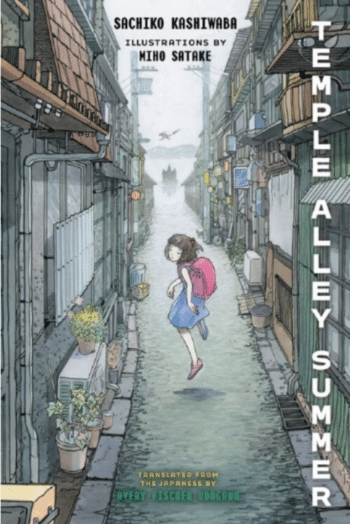
Temple Alley Summer
By Sachiko Kashiwaba, Translated by Avery Fischer Udagawa, Illustrated by Miho Satake (Yonder)
- Fiction
- Set in Japan
Keywords: contemporary, ghosts, supernatural, translation, friendship
Kazu knows something odd is going on when he sees a girl in a white kimono sneak out of his house in the middle of the night—was he dreaming? Did he see a ghost? Things get even stranger when he shows up to school the next day to see the very same figure sitting in his classroom. No one else thinks it’s weird, and, even though Kazu doesn’t remember ever seeing her before, they all seem convinced that the ghost-girl Akari has been their friend for years!
When Kazu’s summer project to learn about Kimyo Temple draws the meddling attention of his mysterious neighbor Ms. Minakami and his secretive new classmate Akari, Kazu soon learns that not everything is as it seems in his hometown. Kazu discovers that Kimyo Temple is linked to a long forgotten legend about bringing the dead to life, which could explain Akari’s sudden appearance—is she a zombie or a ghost? Kazu and Akari join forces to find and protect the source of the temple’s power. An unfinished story in a magazine from Akari’s youth might just hold the key to keeping Akari in the world of the living, and it’s up to them to find the story’s ending and solve the mystery as the adults around them conspire to stop them from finding the truth.
These Culture Notes provide information on key terms from Temple Alley Summer:
Yōkai
A broad term for mysterious phenomena in Japan, yōkai refers to a variety of spirits, entities, and even deities or demons that defy or typical natural phenomena and common perceptions of right and wrong. Yōkai are represented by many different types of beings; for example, yōkai can be fox spirits known as kitsune or turtle-like creatures known as kappa. Some yōkai take on even more unconventional forms, like the kasa-obake, which is often pictured as an umbrella with one eye and one leg. Yōkai can be tricksters or protectors. The term is also used to refer to deities and demons that are not associated with a specific Buddhist temple or Shinto shrine. Yōkai are prevalent in Japanese monster and ghost stories, including anime (Spirited Away, Pom Poko, Yokai Watch, etc.)
Yūrei
Human ghosts, yūrei can take different forms depending on how they died or what brought them back to haunt the world of the living. Typical features associated with yūrei are a white kimono, long black hair, and powers associated either with a particular curse or the place or person they are haunting. Most closely analogous to the Western concept of ghosts, yūrei usually haunt a person or place out of revenge, manipulating the area around them to drive their victim insane or to right the wrongs they experienced while they were alive.
Black Cat (Maneki Neko, Kuro Neko, Bakeneko, etc.)
The black cat in Temple Alley Summer is reminiscent of the distinct ways in which cats take on supernatural significance within Japanese folklore. Cats can take on many good and bad spiritual forms, just like foxes (kitsune) and raccoon dogs (tanuki). As maneki neko or kuro neko, they are seen as a sign of good luck or a messenger from the spirit world. While the former are usually portrayed as white and the latter as black—the Japanese word kuro means black—they are generally seen as cat spirits that protect against evil. Cat spirits can be quite powerful, with one type known as the bakeneko able to create zombies, speak, and shape-shift. These are only a few of the many ways that cats take on power and symbolism as yōkai throughout Japanese cultural history.
Jizō Statues
The bodhisattva Jizō is revered in Japan as a compassionate being who delayed his own enlightenment to help save other beings from suffering and ensure they do not end up in hell after they died. This has led Jizō to take on a different type of significance in Japanese spirituality, where he is seen primarily as a protector of the souls of children who died, including those who died during pregnancy or childbirth (the latter being known as “water children,” or mizuko). To this end, Jizō statues can be seen holding small pinwheels or wearing red bibs, hats and small coats that grieving parents dress them in for protection. This is seen as a way for the Jizō statues to guide the souls safely to the afterlife and protect them from any yōkai or yūrei who may mean harm along the way. Stone statues of Jizō can be found throughout Japan, often at roadsides.
Home Altar (Butsudan/Kamidana)
Most traditional Japanese households have both Buddhist and Shinto home altars. The Buddhist altar (butsudan) is focused on reverence for the family’s ancestors. The Shinto shrine (kamidana) is usually located in the kitchen and is believed to bring good luck to the household. The frequency of offerings on these home altars may depend on the religiosity of the household.
Sandō
Alleys or roads approaching a Buddhist temple or Shinto shrine (sandō) are considered liminal spaces. Acting both as a commercial hub for economic activity near temples and shrines and as a passageway for pilgrims and visitors to switch their mindsets from the secular to the sacred as they approach the temple or shrine, sandō are an integral part of temple and shrine culture in Japan. The setting in the book, Kimyo Temple Alley, corresponds to temple alleys across Japan that have historically served as locations for street stalls that cater to pilgrims. One of the best-known temple alleys in Japan today is Nishi Sandō near Asakusa Temple in Tokyo. Not only does this area offer items such as incense and prayer beads associated with the Buddhist faith and practice, but also small bakeries that offer traditional Japanese treats like dango mochi on a skewer and even modern amenities like McDonalds.
Buddhist Temple Cemeteries
Buddhism is closely associated with funerary rites in Japan. Graveyards are always attached to Buddhist temple complexes. These cemeteries function as sacred spaces where families pay their respects during major holidays or festivals such as Obon in August. Cemeteries in Japan are not only viewed as places of spiritual contemplation, but areas where spirits may persist to dwell after death.
Summer Ghost Stories
In an inversion of Western beliefs surrounding the supernatural, in Japan and other East Asian societies, the time for ghost stories and otherworldly visitations is during the summer months. In Buddhist traditions that spread throughout Japan over the course of several centuries, people would gather in halls to share ghost stories, blowing out lamps one by one until the growing darkness summoned the spirits they were swapping stories about. Sharing ghost stories during the sweltering heat of summer is believed to give people the “chills” to cool them down. This tradition of summer ghost stories has had a deep effect on Japanese culture and media, influencing poetry, manga, anime, and live-action film (such as Ring).
Summer Vacation for Students
The story of Temple Valley Summer corresponds with the time in Japanese school life when students are on summer vacation. The Japanese school year follows a trimester model, with one of the times students are off being between the end of July and the end of August. This summer vacation corresponds nicely with the celebration of Obon, a Buddhist festival honoring the dead throughout the country. In the context of this story, the elements that come together to comprise the crux of the plot—the temple alley, the ghost story, an old temple with the power to bring the dead back to life—would be seen as potent storytelling material naturally associated with the summertime.
Obon (Festival honoring ancestral spirits)
In mid-August, Japanese families travel to their hometowns to celebrate the spirits of their ancestors, making offerings at their graves and participating in festival events. These customs and rites have become codified into the celebration of the three-day festival known as Obon or Bon. Buddhist views on the relationship between the land of the living and the land of the dead mark Obon as a time when spirits come back to pay a visit to the land of the living. At Buddhist temples, it is also seen as a time to quell the spirits of hungry ghosts—restless spirits that can never find satisfaction or peace. Beyond the specific religious aspects of Obon, the festival is seen as a time for families to gather at the end of summer and decompress before the school year starts up again after the summer break.
Author: Matthew Kizior, M.Ed., Central Catholic High School, Pittsburgh, PA
2026
Summary
Temple Alley Summer is a book about friendship, second chances, and the supernatural. We start off being introduced to our main character and narrator, Kazu. Kazu sees the ghost of a girl near his house, which upends his understanding of what’s real and possible in his life. As he investigates, he notices that the same girl—Akari—attends his school. Everyone can see her, but they don’t know her as the ghost that Kazu saw one night. They think that Akari has been their friend and classmate for years. As Kazu and Akari investigate how she has managed to return to the land of the living, he discovers that where he lives used to be known as Kimyo Temple Alley—a place fabled for having a temple that could bring the dead back to life. As they uncover the secrets of the temple and Akari’s past, they gain the help of Kazu’s odd neighbor, Ms. Minakami, in unraveling the reasons why any of this happened in the first place. While Kazu wants to help Akari to fully live her new life, others want the power of the temple to stay a guarded secret. As the two work together to solve the mystery, their friendship deepens.
Analysis
Temple Alley Summer is an engaging book for middle school students, especially those in 7th and 8th grade. Despite the supernatural elements, the book focuses on themes that are relevant to many young teenagers, such as friendship, home, and feeling lost and disoriented when people suddenly enter or leave our lives. In addition, cultural and supernatural elements may pique their attention or remind them of manga or anime they enjoyed in the past.
Cultural and Historical Themes
When it comes to cultural and historical themes, Temple Alley Summer presents a wealth of material and possibilities for elaboration in a text geared towards middle-school readers. The story touches on Japanese ghost stories and a general fascination with the supernatural, including references to Buddhist cosmology. In Japan, the barrier between the world of the living and that of the dead is believed to be thin, something that persists time and again in stories about ghosts and apparitions (yūrei), and the power that certain mysterious phenomena and manifestations (yōkai) have such as foxes (kitsune) and raccoon dogs (tanuki). While Japanese folklore is relatively easy to introduce to students, Buddhist cosmology is much more complicated. However, emphasis on Buddhism’s influence on Japanese life can still be elaborated upon in direct ways to allow students to understand the rich spiritual heritage of certain Japanese practices and beliefs. The story-within-the-story, The Moon Is on the Left, introduces the reader to aspects of melancholic storytelling that focus on the mixed-bag nature of life that is endemic to Japanese forms of literature (mono no aware). All of these elements taken together—and filtered through the main theme of friendship that characterizes the relationship between the characters Kazu and Akari—give an instructor ample opportunity to take these new and fascinating elements their students may be encountering for the first time and help them better grasp what makes other cultures unique and fascinating. Here are some of these cultural and historical elements explained in a bit more detail:
- Yōkai 妖怪 (pronounced: YOO-kah-ee): Yōkai refers to the entire supernatural realm of ghosts and demons. Within this larger category are all sorts of manifestations and phenomena, from human ghosts to inanimate objects that come alive.
- Yūrei 幽霊 (pronounced: YOU-ray): A yūrei is a human ghost, often female. If a person dies violently or dies while experiencing emotional angst, their spirit is trapped between this world and the next. The yūrei might be the crying ghost of a young woman who had been abused by her master, for example. More typically, a yūrei is an angry spirit, bent on revenge for wrongs that have not been righted. She is usually depicted in Japanese art with long hair, a white robe, and no feet. She floats in the air or her face might appear in a paper lantern, for example.
- Mono no Aware 物の哀れ (literally “the pathos of things”): A bittersweet appreciation for the fact that nothing lasts forever, mono no aware within Japanese literature and folktales highlights the inescapable realities of life. Whether through metaphor, figurative language, or concrete plot developments, Japanese literature is suffused with the basic truth that life contains pain as well as joy. In the context of this story, the character of Akari experiences the most acute forms of mono no aware. Kazu feels a sense of bittersweetness over how things develop near the conclusion of the novel.
- Japanese Buddhism: Buddhism was introduced to Japan in the mid-sixth century through Korea. It introduced new teachings, deities, and cosmologies to the Japanese sensibility. Mahayana Buddhism offered a particularly rich tapestry of beliefs. Japanese Buddhism expanded various traditions and strains of thought, especially during the Kamakura period (1192–1333) and afterwards. As Mahayana Buddhism developed in Japan, focus was put on celestial beings, life after death in the Pure Land, and the potency of sacred scriptures and prayers. In short, Japanese Buddhism had particular views that contribute to the specific ways in which Kashiwaba refers to the supernatural in Temple Alley Summer.
Relevance and Reflection: Friendships and the Built Environment
Temple Alley Summer will resonate with middle-school readers regarding the challenges and discoveries they are starting to make as they become more aware of their personal lives and the world around them. On the one hand, the relationship between the two main characters Kazu and Akari highlights how friendships and relationships can start to deepen and develop as students grow older. Even if friendships are relatively new, they can still contain an inner life of hard-earned victories and unexpected endings. In addition to the friendship, Kimyo Temple Alley itself—the built environment—represents both the past and reflects how the alley is used in the present. The past and present of Kimyo Temple Alley contributes to the start and development of Kuzo and Akari’s friendship and gives it what could be called an animating purpose. Students can explore how their own friendships are influenced by their cities, neighborhoods, and the way people interact in and among them in meaningful ways.
Appropriate Grade Levels
Temple Alley Summer is best used with middle-school students in 7th and 8th grade. The book is accessible and uses easy-to-understand vocabulary while challenging the reader to understand core concepts and ideas from a different cultural perspective within the context of an engaging mystery. This text provides an introduction to higher level reading concepts (character POV, the reliability of narration, and more) to better prepare students for the transition to 9th grade, where they will be asked to reader denser and more complicated material.
Activities
- Reading Activity Setting Map – Use a map alongside the reading of the text. Students could be asked to create the map as they read the text together or as a form of review. This exercise helps students to expand their imagination by visualizing scenes from the novel. Students could use the map activity to draw out Kimyo Temple Alley, label important locations within the temple alley and around it and give students a chance to draw out old temple locations. In this way, the novel starts to become a much more real and lived-in place for the student as they continue to read the plot and learn more about where particular scenes take place.
- Friendship Analysis – A T-chart handout could be used to compare Kazu and Akari at the beginning and end of the story. How do the characters change throughout the course of the story, and how does the relationship between Kazu and Akari evolve? Special emphasis should be placed on students developing comprehension questions and writing down key details and moments from the story that relate to friendship.
- Visual Arts Project – This is a creative arts project that students can do either individually or in groups of two, ideally in an art class. Students could select a theme or symbol from the novel—the temple, the alleyway, ghosts, friendship, light, summer, etc.—and explore it visually. Students might also choose to illustrate a key moment from the story, which could give them a deeper understanding of what it means to be a friend in trying times.
- Cultural Comparison of Beliefs About the Supernatural – Encourage students to explore the differences between how we in the West view supernatural phenomena versus how Japanese do. By looking at how the characters in Temple Alley Summer remember the dead and communicate with the supernatural, and then comparing it to how we think about these things, students will see the stark differences between the two traditions. This cultural comparison can then be shared through oral presentations and possibly even through accompanying material, like a short essay, worksheet, poster, trifold, or other format.
Common Core Standards
CCSS.ELA-Literacy.RL.K.1
With prompting and support, ask and answer questions about key details in a text.
CCSS.ELA-Literacy.RL.K.2
With prompting and support, retell familiar stories, including key details.
CCSS.ELA-Literacy.RL.K.3
With prompting and support, identify characters, settings, and major events in a story.
CCSS.ELA-Literacy.RL.K.4
Ask and answer questions about unknown words in a text.
CCSS.ELA-Literacy.RL.K.5
Recognize common types of texts (including storybooks, poems, and more).
CCSS.ELA-Literacy.RL.K.6
With prompting and support, name the author and illustrator of a story and define the role of each in telling the story.
CCSS.ELA-Literacy.RL.K.7
With prompting and support, describe the relationship between illustrations and the story in which they appear (e.g., what moment in a story an illustration depicts).
CCSS.ELA-Literacy.RL.K.9
With prompting and support, compare and contrast the adventures and experiences of characters in familiar stories.
CCSS.ELA-Literacy.RL.K.10
Actively engage in group reading activities with purpose and understanding.
Literature and Media Connections
To highlight the differences between ghost stories in Japan and the West, the literature and media connections for Temple Alley Summer could include a compare-and-contrast assignment with a Goosebumps book. Students could also be introduced to manga (Japanese comic books) or anime (Japanese animation) that highlight ghosts and monsters in ways that would help students better understand how these types of characters are regarded in a different cultural context. A great and easy-to-access manga text for the middle school reading level would be Shigeru Mizuki’s GeGeGe no Kitaro. This book features the main character Kitaro with a rotating cast of Japanese ghosts and monsters. Akari in Temple Alley Summer is a spirit with feelings and motivations that make her seem just as human as everyone else around her. Hayao Miyazaki’s Spirited Away could be shown to the class, given how both stories portray girls with connections to the spirit world. Also, Sachiko Kashiwaba’s other book—The Village Beyond the Mist—is cited as an important influence on Spirited Away.
Author: Matthew Kizior, M.Ed., Central Catholic High School, Pittsburgh, PA
2026
NCTA webinar with Sachiko Kashiwaba, author, and Avery Udagawa, translator
Winner of the 2022 Mildred L. Batchelder Award
A July/August 2021 Kids’ Indie Next Pick
A Junior Library Guild Gold Standard Selection
The International Board on Books for Young People (IBBY) 2024 Honor list for translator Avery Fischer Udagawa
© 2024 NCTAsia