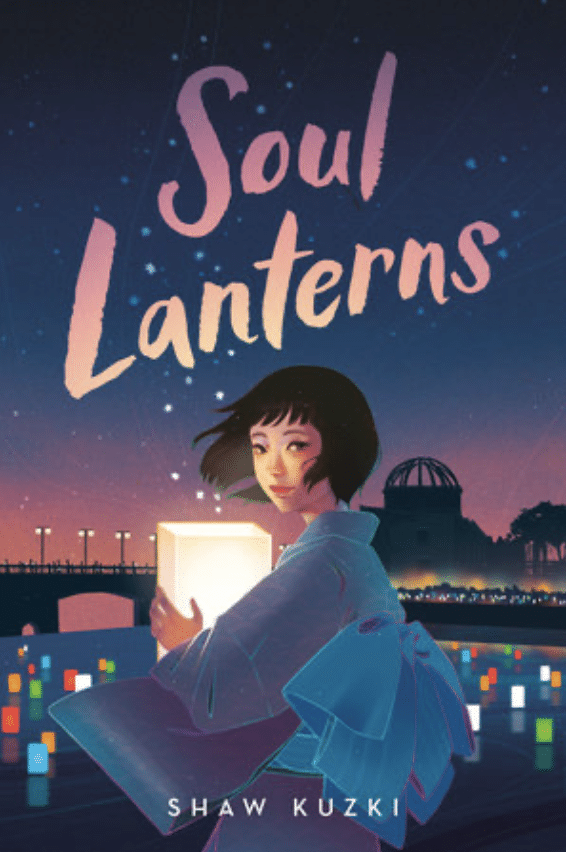
Soul Lanterns
By Shaw Kuzki, Translated by Emily Balistrieri (Delacorte Press)
- Fiction
- Set in Japan
Keywords: translation, war, Hiroshima, grief, family, death
Twelve-year-old Nozomi lives in the Japanese city of Hiroshima. She wasn’t even born when the bombing of Hiroshima took place. Every year Nozomi joins her family at the lantern-floating ceremony to honor those lost in the bombing. People write the names of their deceased loved ones along with messages of peace, on paper lanterns and set them afloat on the river. This year Nozomi realizes that her mother always releases one lantern with no name. She begins to ask questions, and when complicated stories of loss and loneliness unfold, Nozomi and her friends come up with a creative way to share their loved ones’ experiences. By opening people’s eyes to the struggles they all keep hidden, the project teaches the entire community new ways to show compassion.
Soul Lanterns is an honest exploration of what happened on August 6, 1945, and offers readers a glimpse not only into the rich cultural history of Japan but also into the intimate lives of those who recognize–better than most–the urgent need for peace.
Atomic Bomb dropped on Hiroshima, 1945
In the final phase of the Pacific War (the theater of war fought in Asia during World War II), the U.S. and Allied forces prepared to invade Japan. American forces assaulted the island of Okinawa on April 1, 1945. The Battle of Okinawa was one of the bloodiest of the war: 50,000 U.S. soldiers and well over 120,000 Japanese soldiers and civilians died during three months of intense fighting, ending in victory by the American forces. This gave them control of a strategic location relatively close to the main islands of Japan, from which they could launch an invasion. During the same period, Americans continued bombing major cities in Japan. The bombing of Tokyo on March 9 and 10 killed at least 100,000 and left one million homeless.
On August 6, 1945, the United States dropped an atomic bomb on Hiroshima, and three days later on Nagasaki. The bombings hastened the unconditional surrender of Japan. After the emperor announced the surrender on August 15, the papers were signed on September 2, 1945, on the USS Missouri in Tokyo Bay.
The atomic bomb dropped on Hiroshima detonated 600 meters above the city center. Intense heat instantly vaporized any living things around ground zero. Those who did not die instantly suffered from severe burns and radiation poisoning, and most died within a few days. The effects of radiation (leukemia, for example) lingered on, claiming the lives of thousands more. Today, more than 20,000 survivors are believed to be still alive. Any remaining radiation from the A-bomb now is undetectable; it is at the same level as the normal background radiation measured anywhere. There is no residual radioactivity in Hiroshima or Nagasaki.
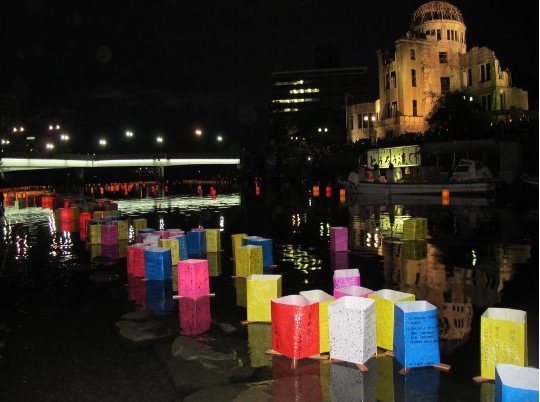
Tōrōnagashi
Tōrōnagashi, “setting lanterns afloat,” is a tradition in some parts of Japan practiced on special occasions or during the August bonfestival. In the case of Hiroshima, tōrōnagashi is a new tradition created a few years after the atomic bombing to commemorate the souls of the deceased. Small lanterns are floated down the Motoyasu River that runs by the Genbaku Dome. Many of these carry a message to the deceased or a message of peace.
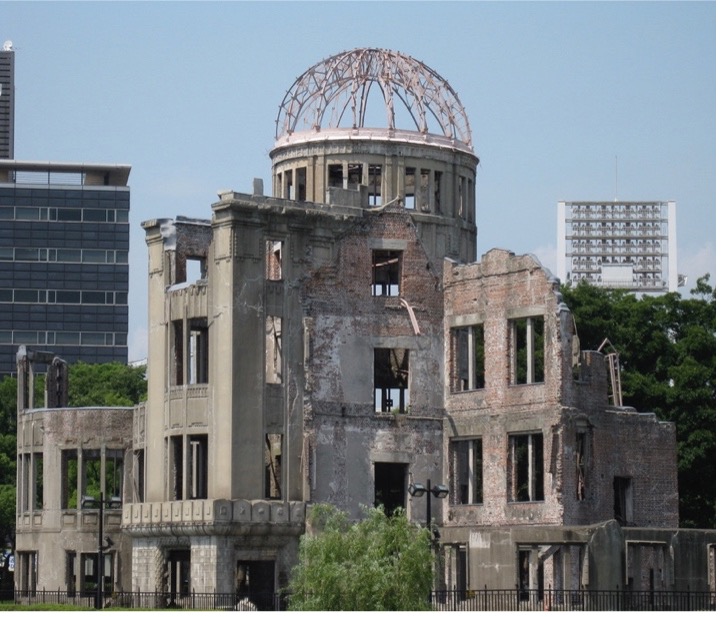
The Genbaku Dome
The Genbaku Dome is the former Hiroshima Prefecture Industrial Promotion Hall. The large domed structure has been preserved to show how it appeared days after the bombing. It is the main symbol of the bombing, located in Hiroshima Peace Memorial Park.
Author: Hiroshi Nara, emeritus professor, University of Pittsburgh
2025
Soul Lanterns is a young adult novel set in Hiroshima that focuses on themes such as cultural identity, loss, and community connection. Ideal for grades 6–8, this book can be used in a variety of classroom settings.
Soul Lanterns opens on August 6, 1970, twenty-five years after an atomic bomb was dropped on Hiroshima at the end of World War II. Twelve-year-old Nozomi is attending the annual lantern floating festival with her mother, who is a survivor of the bombing. The lanterns honor those who died on August 6, 1945. Many people write the name of someone they lost on the lantern, and also messages about peace.
Nozomi realizes she has questions about many of the people in her life: What have they experienced? Who have they lost? What should we remember about our history? Nozomi notices her mother releasing a lantern with no name. Who is the mysterious lantern in honor of? As Nozomi works to discover who her mother has lost, she begins to uncover many stories of lives lost and families devastated by the bombing and its aftermath (see Culture Notes for this book for a short historical overview). The novel details many stories that are still unresolved.
Nozomi’s inquisitive nature leads her to learn more about others in her life and who they have lost. She uncovers information about missing schoolchildren and the heartbreak experienced by their families, her art teacher’s lost love, and a mother’s search for answers to a part of her son’s life she did not know about. Each layer reveals a new story of life, loss, history, and grief.
Appropriate Student Population
Middle school students will find the text accessible and engaging. It has the potential to work well for early-advanced readers or reluctant high school readers, as well. The novel provides many universal themes that would work perfectly in an English Language Arts setting, but it also allows for many cross-curricular options.
Cross-Curricular Suggestions
A history class can easily use this text as an entry point for discussing Hiroshima and the lasting impacts of the atomic bomb. Students could begin by learning facts about the event and its aftermath. They could be asked to consider the lasting impacts of the bombing of Hiroshima. What has the world learned from this event, and what lessons have yet to be learned?
An art class can challenge students to learn how lanterns are made. This provides a historical and cultural connecting point. The author provides insights, explaining, “The lantern floating ceremony is said to have started around 1947 or 1948, when people who lost family or friends began releasing handmade lanterns in remembrance. Usually the lantern bore the deceased person’s name and the name of the person who released it, but in recent years, it has become common to see visitors both domestic and international writing messages of peace.”[1] This tradition has expanded with international participation. Students could also consider other types of historical memorials and how they were created.
Science class can provide a deeper dive into the aftermath of this event. Depending on grade level and research abilities, student can be provided with articles or can be asked to do their own research. Topics may include the physical and emotional toll the bomb had on the survivors. Additionally, a more advanced class could research the impacts of generational trauma.
Math classes could use this book as an entry point to discuss statistics and data. Students can be asked to analyze numbers and to create graphs, charts, or scatter plots to show casualties, population changes, and building damage.
Each of these starting ideas can be an extension to a unit taught in an ELA classroom. While reading this novel, in ELA, students may have the opportunity to consider and reflect on the importance of sharing a personal journey or retelling a piece of history. As Nozomi introduces new characters and their stories, students could be asked to consider each perspective and how they compare to each another. How do these stories overlap with other texts that have been read? And what does this book teach about our shared humanity, no matter one’s place of origin?
Soul Lanterns presents many intersections for cross-curricular planning, as the author focuses on universal themes. While sharing an important historical narrative, she continuously brings the reader back to relatable individual stories.
Select Common Core ELA Standards:
- RL.6.2 / RL.7.2 / RL.8.2– Determine a theme or central idea of a text and analyze its development over the course of the text.
- RL.6.3 / RL.7.3 / RL.8.3– Analyze how particular elements of a story interact (characters, setting, plot).
- RL.6.6 / RL.7.6 / RL.8.6– Explain or analyze how an author develops the point of view of the narrator or characters.
- RL.7.9 / RL.8.9– Compare and contrast a fictional portrayal of a time, place, or character with a historical account of the same period.
- RI.6.9 / RI.7.9 / RI.8.9– Analyze how multiple texts address similar themes or topics to build knowledge or compare approaches.
- W.6.1 / W.7.1 / W.8.1– Write arguments to support claims with clear reasons and relevant evidence.
- W.6.9 / W.7.9 / W.8.9– Draw evidence from literary or informational texts to support analysis, reflection, and research.
- SL.6.1 / SL.7.1 / SL.8.1– Engage effectively in collaborative discussions with diverse partners.
Author: Jennifer Schmidt, English Teacher, North Allegheny School District, 2026.
2026
[1] Shaw Kuzki, Soul Lanterns, trans. Emily Balistrieri, First Yearling ed. (New York: Yearling, 2022), 161–162.
© 2024 NCTAsia